

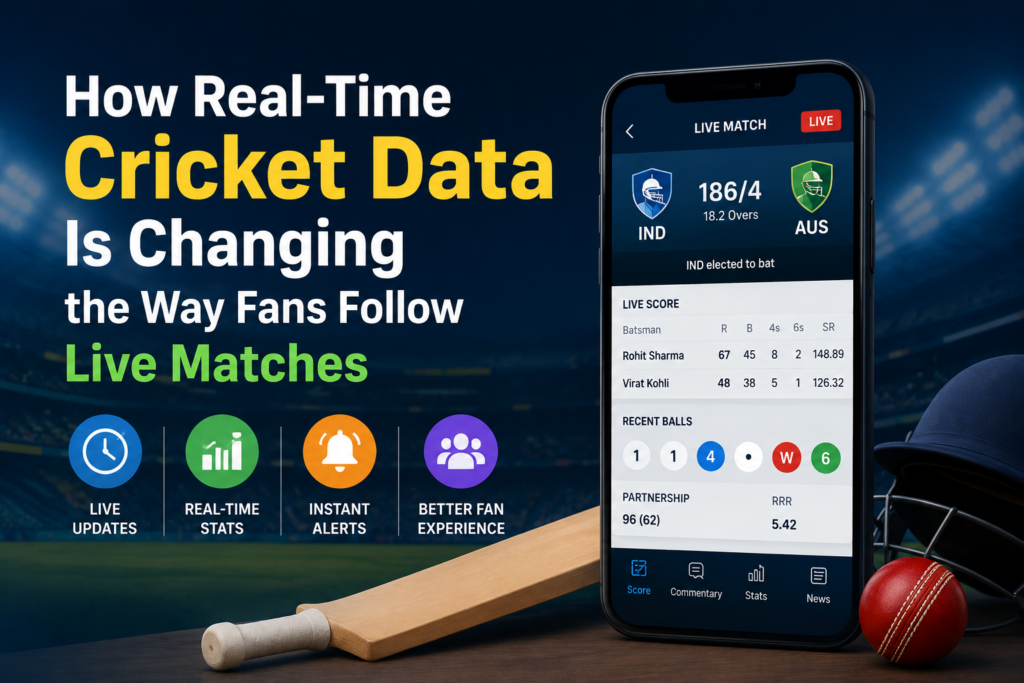
Cricket has always been a numbers-driven sport, but the way fans access those numbers has changed dramatically. A few years ago, following a live match often meant waiting for television graphics, radio commentary, or a score update. Today, fans can see ball-by-ball events, run rates, partnerships, player statistics, and match situations almost instantly.
For someone using a cricket exchange id real-time information can also provide context for understanding how an exchange market responds to events on the field. However, live data should be treated as information rather than a guarantee of what happens next.
The growth of live scoring technology has made cricket more interactive. Official cricket bodies and data providers now distribute detailed live information across websites, apps, media platforms, and other digital services. The for example, has worked with official data partners to provide live ball-by-ball information and related match data.
This shift has changed the fan experience. Instead of simply asking, “What is the score?”, viewers can now ask, “Why has the match changed?”
What Is Real-Time Cricket Data?
Real-time cricket data refers to information that is updated as a match progresses. It can include much more than the current score.
Common examples include:
- Runs scored from each delivery
- Wickets and dismissal types
- Overs completed
- Current run rate
- Required run rate
- Batter scores and strike rates
- Bowling figures
- Partnerships
- Fall of wickets
- Boundaries and sixes
- Extras
- Target and runs remaining
- Playing XI information
- Match events and commentary
Modern live cricket services can combine these details into a single match view. Official and commercial cricket data systems can also distribute detailed ball-by-ball information to digital platforms.
The key difference is speed. A traditional scorecard gives you the match position. Real-time data adds the sequence of events that produced that position.
Why Real-Time Data Matters to Cricket Fans
A score alone can sometimes hide the story of a match.
Imagine a team is 120/3 after 15 overs. That number tells you the score and wickets, but it does not fully explain the situation.
The team could have scored 45 runs during the previous three overs. Alternatively, it might have lost two wickets and scored only 15 runs.
Real-time information helps fill that gap.
Fans can look at recent overs, partnerships, wickets, required rate, and individual performances to understand whether a team is gaining control or losing momentum.
This makes watching cricket more analytical without requiring advanced statistical knowledge.
Ball-by-Ball Updates Give Fans More Context
Ball-by-ball information is one of the most useful developments in live cricket coverage.
Instead of seeing only the score after an over, fans can follow the sequence:
- Dot ball
- Single
- Four
- Two runs
- Wicket
- Single
That sequence tells a much richer story.
It can show a bowler creating pressure, a batter breaking the pressure with a boundary, or a wicket changing the direction of an innings.
The has previously described official live data services as including detailed ball-by-ball data, squad statistics, and scorecards. More recent partnerships have also focused on distributing low-latency live match data to digital and licensed platforms.
For fans following a match on a mobile device, this means they can stay informed even when they cannot watch every delivery.
The Most Useful Live Cricket Statistics
Not every statistic deserves equal attention. The most useful numbers depend on the match format and situation.
1. Current Run Rate
Current run rate shows how quickly a batting side is scoring.
It is particularly useful in limited-overs cricket because scoring speed has a direct relationship with the remaining overs.
2. Required Run Rate
During a chase, required run rate provides another important reference point.
It shows the scoring rate needed to reach the target based on the remaining deliveries.
A rising required rate can indicate increasing pressure, but it does not automatically mean a team will lose. Wickets in hand, batter quality, pitch conditions, and remaining overs all matter.
3. Partnership Data
A partnership can reveal stability that the main scorecard does not immediately show.
For example, a team may have lost early wickets but recovered through a long partnership. That information gives fans a better understanding of how the innings has developed.
4. Bowling Figures
Overs, runs conceded, wickets, economy rate, and recent spells help viewers understand which bowlers are creating pressure.
In a T20 match, even a short spell can significantly affect the final innings.
5. Recent Over Performance
Recent scoring trends can be useful when interpreted alongside the wider match situation.
A team scoring 12 runs in one over has not necessarily gained control. The context could include a dropped chance, a difficult pitch, or an unusually aggressive batting approach.
This is why individual statistics should not be viewed in isolation.
How Live Data Helps Fans Understand Match Momentum
“Momentum” is often used in cricket discussions, but it is not a single official statistic.
Instead, fans usually infer momentum from several developments.
These can include:
- Consecutive boundaries
- Wickets falling close together
- A growing partnership
- Declining scoring rate
- Increasing required run rate
- Successful bowling changes
- Batters struggling to rotate the strike
- A sudden change in fielding pressure
Consider a T20 chase where the batting side needs 70 runs from 42 balls.
The required rate may look manageable. But if two wickets fall during the next three overs and only 18 runs are scored, the situation changes quickly.
Real-time data allows fans to see that change as it happens rather than discovering it several overs later.
How Real-Time Data Connects With Cricket Exchange Betting
Real-time cricket information also has a connection with cricket exchange betting where market prices can change as match events occur.
For example, a wicket can alter the perceived chances of the batting side. A fast-scoring partnership can have the opposite effect.
This does not mean data predicts the next event. It simply provides information about the current match state.
An exchange market can respond to factors such as:
- Current score
- Wickets remaining
- Overs remaining
- Batting strength
- Bowling resources
- Required scoring rate
- Recent match events
- Changing expectations among market participants
A cricket exchange id may provide access to an exchange account, but the ID itself does not make a prediction more accurate. Understanding the underlying match information remains more important.
Fans should also remember that live markets can change quickly and that cricket remains uncertain. Data describes what has happened and helps explain the current situation; it cannot guarantee what will happen next.
Where Tiger Exchange Fits Into the Data-Driven Fan Experience
The term Tiger exchange is associated with the broader exchange-platform environment, where users may follow sports markets alongside live sporting events.
For an educational discussion, the more useful point is how digital platforms connect live match information with the viewing experience.
The Tigerxplay website currently presents cricket and sports exchange-related content alongside live-match and account-related information. Its site structure also includes sections covering cricket IDs, betting exchange topics, the Tiger Exchange App, FAQs, and responsible gaming.
For users interested in the platform side of cricket exchanges, this creates an important distinction:
Live cricket data tells you what is happening on the field. An exchange platform shows how participants and markets may respond to those events.
Those are related, but they are not the same thing.
Why Data Speed Matters During Live Matches
Timing is a major part of live sports information.
A wicket can change a match within seconds. A boundary can alter the required rate. A review can temporarily create uncertainty before the official decision is confirmed.
This is why modern cricket-data systems focus heavily on latency and accurate event reporting.
The has used official data partnerships to distribute live ball-by-ball information and low-latency data across digital platforms and licensed operators.
However, “real-time” does not always mean perfectly instantaneous.
Different platforms may have different delays caused by data collection, processing, internet connections, broadcasting rights, or app refresh rates.
For important match information, fans should prefer reliable sources and check official scorecards where possible.
The for example, provides official match schedules and promotes its official app for live scores and other cricket content.
Live Data Is More Than Just a Scoreboard
One of the biggest changes in cricket coverage is the move from simple scorekeeping toward contextual analysis.
A modern digital match centre may combine:
| Data Type | What It Helps Explain |
| Live score | Current match position |
| Ball-by-ball feed | Sequence of events |
| Run rate | Scoring speed |
| Required rate | Chase pressure |
| Partnership | Batting stability |
| Bowling figures | Bowler impact |
| Fall of wickets | Important innings turning points |
| Player statistics | Individual contribution |
| Recent overs | Short-term match trend |
This combination makes it easier for fans to build their own understanding of the game.
A reader does not need to study every statistic. The goal is to identify the numbers that answer the question they currently have.
Common Mistakes When Reading Live Cricket Data
More information does not always mean better understanding.
Looking at One Number
A required run rate can rise, but that does not automatically indicate defeat.
Consider wickets in hand, set batters, remaining overs, and the quality of the bowling attack.
Treating Predictions as Facts
Win probabilities and forecasts are estimates. They are not guaranteed outcomes.
A team with a high projected chance of winning can still lose.
Ignoring Match Format
A statistic that matters in a Test match may have a different meaning in a T20.
The number of overs, pitch conditions, scoring patterns, and strategic priorities all change.
Confusing Speed With Accuracy
The fastest update is not necessarily the most reliable update.
A confirmed wicket decision is more useful than an early notification that later changes.
Reacting to Every Delivery
Cricket contains natural fluctuations.
One dot ball does not transform a match. One boundary does not guarantee a batting turnaround.
Looking at several overs and the wider match context usually provides a better picture.
How Fans Can Use Live Data More Effectively
A simple process can make live cricket information easier to understand.
Step 1: Check the Match State
Look at the score, wickets, overs, and target.
Step 2: Check the Recent Pattern
Review the last few overs rather than focusing on one delivery.
Step 3: Identify the Main Change
Ask what caused the match situation to shift.
Was it a wicket, partnership, scoring burst, bowling spell, or change in required rate?
Step 4: Check the Resources Available
Consider wickets in hand, remaining overs, available bowlers, and the batters currently at the crease.
Step 5: Separate Information From Prediction
Use statistics to understand the present situation. Do not treat forecasts as certainty.
This approach is useful whether someone is simply watching a match or researching exchange-related markets.
Responsible Use of Cricket Data
Real-time information can make cricket more engaging, but it can also encourage impulsive decisions when connected with betting or exchange markets.
Rapidly changing prices and match situations can create pressure to act quickly.
Fans who engage with cricket exchange betting should understand the financial risks, follow applicable laws and platform rules, and avoid treating live statistics as a way to guarantee returns.
Responsible gaming means keeping entertainment and financial decisions within sensible personal limits.
The educational value of live data remains useful even without betting. Fans can use the same information to understand tactics, compare performances, discuss matches, and follow tournaments more closely.
What the Future of Live Cricket Data May Look Like
The next stage of cricket data is likely to focus on greater context rather than simply producing more numbers.
Fans already have access to live scores, player statistics, ball-by-ball commentary, and visual match information. Cricket applications are also experimenting with richer visualisations and live match features.
Future systems may make it easier to understand complex situations through:
- Automated match summaries
- Advanced player comparisons
- Visual pitch maps
- Ball-by-ball trend analysis
- Context-aware notifications
- More personalised match dashboards
- AI-assisted explanations of statistical changes
The important development is not simply faster data. It is a better interpretation.
A fan should be able to look at a live match centre and quickly understand what changed, why it changed, and what factors matter next.
Key Takeaways
- Real-time cricket data has changed from basic score checking to deeper match analysis.
- Ball-by-ball information provides context behind the score.
- Run rate, required rate, partnerships, wickets, and recent overs are useful when viewed together.
- Match momentum is better understood through multiple events rather than one statistic.
- Real-time data can influence how cricket exchange markets respond to match events, but it cannot guarantee outcomes.
- A cricket exchange id provides account access where applicable; it does not replace independent understanding of the game.
- Tiger exchange fits into the broader digital exchange environment, while live cricket data remains the source of information about the match itself.
- Official and reliable data sources should be preferred when accuracy matters.
- Responsible use is especially important when live data is connected with betting or exchange activity.
Conclusion
Real-time cricket data has changed what it means to follow a live match. Fans no longer have to depend on a single score or wait for a post-match summary. They can follow individual deliveries, partnerships, scoring rates, bowling performances, and important turning points as they happen.
That information becomes even more useful when fans learn to connect the numbers with match context. A score tells you where the game stands. Ball-by-ball data helps explain how it got there.
For people researching a cricket exchange id or learning about cricket exchange betting, this distinction matters. Live data can explain why market expectations change, but it cannot remove uncertainty from sport.
The future of cricket viewing will likely involve even more detailed data and smarter ways of presenting it. The real value will come from turning that information into clear understanding rather than simply adding more numbers to the screen.
Frequently Asked Questions
What is real-time cricket data?
Real-time cricket data is live information about a match, including scores, wickets, deliveries, player statistics, run rates, partnerships, and other match events. It is updated as the game progresses.
Why is ball-by-ball data useful?
Ball-by-ball data shows the sequence behind a score. It helps fans understand scoring patterns, wickets, pressure, partnerships, and other changes that may not be obvious from the overall scorecard.
Does real-time data predict who will win?
No. Real-time data describes the current match situation and can support statistical estimates, but cricket remains uncertain. Predictions and probabilities should never be treated as guaranteed results.
How does live data affect cricket exchange betting?
Live match events can influence exchange-market expectations. A wicket, boundary, partnership, or change in required rate may cause prices to move. The movement reflects changing expectations rather than a guaranteed outcome.
What does a cricket exchange id provide?
A cricket exchange id generally refers to an account or identification used to access an exchange-related platform. Its exact features depend on the service providing it.
Is a required run rate enough to judge a chase?
No. The required run rate is only one part of the picture. Wickets in hand, remaining overs, current batters, bowling resources, pitch conditions, and recent scoring all provide additional context.
Where can Indian fans check official cricket information?
For Indian cricket, it provides official fixtures, results, and other team and competition information through its digital platforms. They also provide official information for international competitions.
Can live cricket data be delayed?
Yes. Different services can have different delays because of data collection, processing, network conditions, broadcasting arrangements, and platform refresh rates. “Live” does not always mean perfectly instantaneous.
How should beginners read a live cricket scorecard?
Start with the score, wickets, overs, and target. Then look at recent overs, partnerships, required rate, and current batters or bowlers. This provides a clearer picture than focusing on one statistic.
Should live statistics be used to make betting decisions?
Statistics can provide information, but they cannot guarantee an outcome. Anyone participating in betting or exchange activity should consider financial risk, applicable laws, platform rules, and responsible-gaming principles.