

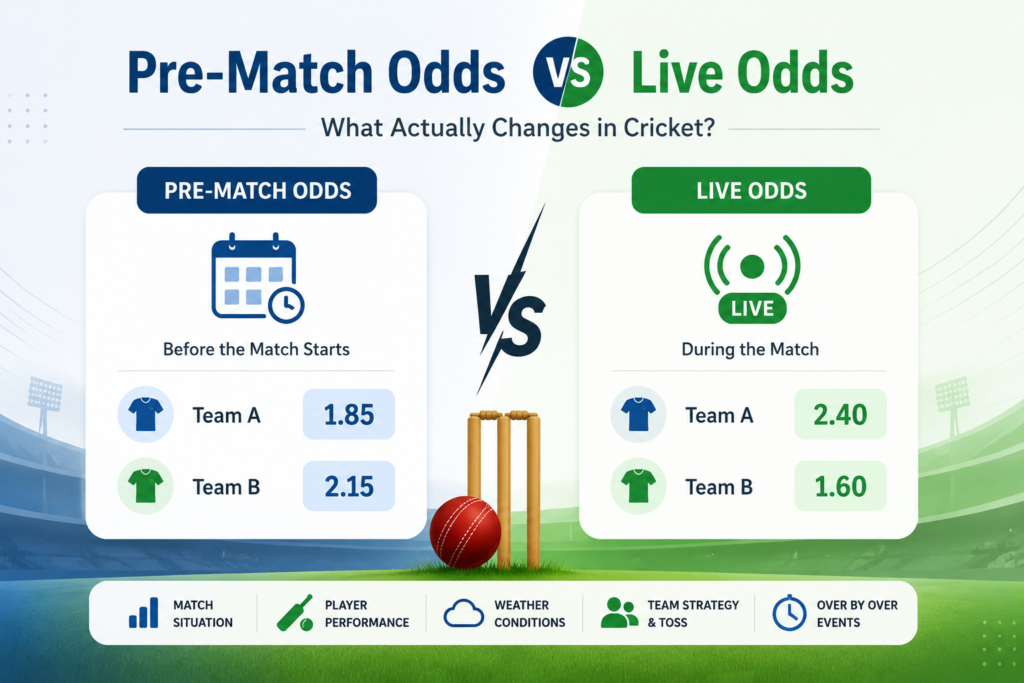
Cricket fans who follow exchange markets often notice that odds can look completely different before a match starts and a few overs later. A team that was considered the favorite before the toss may suddenly become the underdog after an early collapse. This raises an important question: what actually changes?
The answer is information.
Before the first ball is bowled, markets rely on available information such as team strength, recent form, pitch conditions, weather forecasts, venue history, and expected playing XIs. Once the match begins, new information arrives with every delivery. Markets react immediately to wickets, partnerships, run rate changes, injuries, weather interruptions, and momentum shifts.
For users of Tigerexch, understanding these changes can help make sense of how exchange markets move throughout a cricket match. The goal is not to predict outcomes with certainty but to understand why prices move when they do.
What Are Pre-Match Odds?
Pre-match odds are the prices available before a match starts.
These odds reflect the market’s assessment of each team’s chances based on information known before play begins.
Common factors influencing pre-match odds include:
- Team form
- Head-to-head records
- Venue history
- Pitch reports
- Weather forecasts
- Playing XI announcements
- Injury updates
- Toss expectations
For example, if India enters a match with a stronger batting lineup and a good record at a particular venue, the market may assign them a higher probability of winning.
What Pre-Match Odds Really Represent
Pre-match odds are not predictions from a single expert.
In exchange markets, they represent the collective opinion of participants reacting to available information and market demand. Prices often continue to adjust until the match begins as new information becomes available.
What Are Live Odds?
Live odds, also called in-play odds, are prices that update while the match is in progress.
Unlike pre-match odds, live odds incorporate what is actually happening on the field.
Every important event can affect market expectations:
- Wickets
- Boundaries
- Partnerships
- Required run rate
- Powerplay performance
- Bowling spells
- Weather interruptions
- Match momentum
Live odds often change ball by ball because the probability of winning changes throughout the game. Real-time score updates, partnerships, and match situations play a major role in these movements.
Tigerexch and Cricket Exchange Markets
How Exchange Markets Differ
A Cricket exchange works differently from traditional fixed-price systems.
Exchange markets are driven by participants who back and lay outcomes against one another. As new information enters the market, prices adjust to reflect changing expectations. This creates dynamic odds movement rather than static pricing.
For users accessing markets through an online exchange id, understanding price movement is often more important than simply watching the score.
Pre-Match Odds vs Live Odds: Quick Comparison
| Factor | Pre-Match Odds | Live Odds |
| Timing | Before match starts | During match |
| Information Source | Historical and pre-game data | Real-time match events |
| Price Movement | Usually gradual | Often rapid |
| Major Influences | Team news, pitch, weather, toss | Wickets, runs, partnerships |
| Volatility | Lower | Higher |
| Updates | Periodic | Ball-by-ball |
This difference explains why a team’s odds can change dramatically within a few overs.
What Causes Pre-Match Odds to Change?
Even before the match begins, odds rarely remain fixed.
1. Playing XI Announcements
A late injury or unexpected team selection can influence market confidence.
If a star batter or strike bowler is unavailable, odds may shift immediately. Playing XI announcements are often among the biggest drivers of pre-match movement.
2. Pitch Reports
Pitch conditions affect expected scoring patterns.
A dry surface may favor spinners, while a green pitch may assist seam bowlers.
3. Weather Forecasts
Rain threats can impact both team strategies and market expectations.
In limited-overs cricket, weather interruptions can significantly affect probabilities.
4. Toss Result
The toss can have a noticeable impact at certain venues.
On grounds where chasing has historically been successful, odds may shift immediately after the toss.
What Causes Live Odds to Change?
Once the match begins, live odds become highly responsive.
1. Wickets
Wickets are usually the most influential single event.
Losing a top-order batter early often causes a larger shift than losing a lower-order player later in the innings. Market reaction is often immediate.
2. Run Rate Changes
In T20 cricket, scoring speed matters.
A team scoring quickly may see their winning probability improve even if no wickets have fallen.
3. Required Run Rate
During a chase, markets constantly evaluate whether the batting side is keeping up with the target.
A rising required rate often puts pressure on the chasing side and affects odds accordingly.
4. Partnerships
Strong partnerships stabilize innings and improve market confidence.
A 100-run partnership can significantly alter expectations compared to a side that is losing wickets regularly.
5. Weather Interruptions
Rain delays and revised targets can cause sudden price adjustments.
Markets must quickly reassess winning probabilities based on the new match situation.
Example: How Odds Can Change During a Match
Imagine a T20 match.
Before the Match
Team A: 1.80
Team B: 2.10
The market slightly favors Team A.
After the Toss
Team A wins the toss and chooses to chase on a venue known for successful chases.
Team A’s odds shorten slightly.
After 5 Overs
Team A is 28/3.
The market now sees Team B as the favorite.
After 15 Overs
A strong partnership takes Team A to 130/3.
Odds begin moving back toward Team A.
Final Overs
Required run rate drops and wickets remain in hand.
The market adjusts again based on the changing match situation.
This constant reassessment is what makes live odds different from pre-match pricing.
Common Mistakes New Users Make
Assuming Pre-Match Odds Stay Relevant
Once the match starts, the market focuses more on current conditions than pre-match expectations.
Overreacting to One Event
Not every boundary or wicket completely changes a match.
Context matters.
Ignoring Match Situation
Run rate, wickets remaining, batting depth, and overs left often matter more than the score alone.
Confusing Odds With Certainty
Odds represent probabilities, not guarantees.
Unexpected events remain part of cricket.
Understanding Market Psychology
Markets do not react only to statistics.
They also respond to participant behavior.
Factors affecting movement include:
- Public sentiment
- Match momentum
- Liquidity levels
- Demand for certain prices
- New information entering the market
This is why odds movement can sometimes appear larger than expected. Exchange participants react to both facts and expectations.
How an Online Exchange ID Fits Into the Process
An online exchange id provides access to exchange markets where prices are continuously updated.
For many users, the value lies in understanding:
- How markets react
- Why prices move
- Which events influence probabilities
- How information is reflected in odds
Learning these fundamentals creates a clearer understanding of exchange-based cricket markets.
Responsible Participation Matters
Cricket remains unpredictable.
Even the strongest teams lose matches, and unexpected performances can change outcomes quickly.
Anyone following exchange markets should:
- Set personal limits
- Avoid emotional decisions
- Focus on understanding information
- Never assume any result is guaranteed
Responsible participation helps keep the experience enjoyable and informed.
Key Takeaways
- Pre-match odds are based on information available before play begins.
- Live odds incorporate real-time match events.
- Wickets, partnerships, run rates, and weather are major drivers of live price movement.
- Toss results, team news, and pitch reports influence pre-match markets.
- Exchange markets constantly reassess probabilities as new information becomes available.
- Odds reflect changing expectations, not guaranteed outcomes.
- Understanding market movement is often more useful than simply watching the score.
Conclusion
The biggest difference between pre-match odds and live odds is information. Before a match, markets rely on predictions based on known factors. Once the game starts, every ball creates new information that can influence probabilities and market sentiment.
For users following Tigerexch, understanding how a online exchange id reacts to real-time events can provide a clearer view of why prices move throughout a match. Whether it is a wicket in the powerplay, a match-winning partnership, or a sudden weather interruption, live odds are simply the market’s way of reflecting the latest information available.
FAQs
1. What are pre-match odds in cricket?
Pre-match odds are prices available before a match begins and are based on factors such as team form, pitch conditions, weather forecasts, and squad announcements.
2. What are live odds?
Live odds are real-time prices that change throughout a match based on what is happening on the field.
3. Why do cricket odds change during a match?
Odds change because new information becomes available, including wickets, partnerships, scoring rates, and changing match conditions.
4. Does the toss affect cricket odds?
Yes. At some venues, the toss can influence market expectations, especially when chasing or batting first offers a known advantage.
5. Are live odds more accurate than pre-match odds?
Live odds include real-time information, while pre-match odds rely on predictions before the match begins.
6. What is a cricket exchange?
A cricket exchange is a marketplace where participants can back and lay outcomes against one another rather than relying on fixed prices.
7. What causes the biggest live odds movements?
Wickets, major partnerships, rapid scoring bursts, and weather interruptions often create the largest price changes.
8. What is an online exchange id?
An online exchange id is an account credential used to access exchange-based cricket markets and related features.