

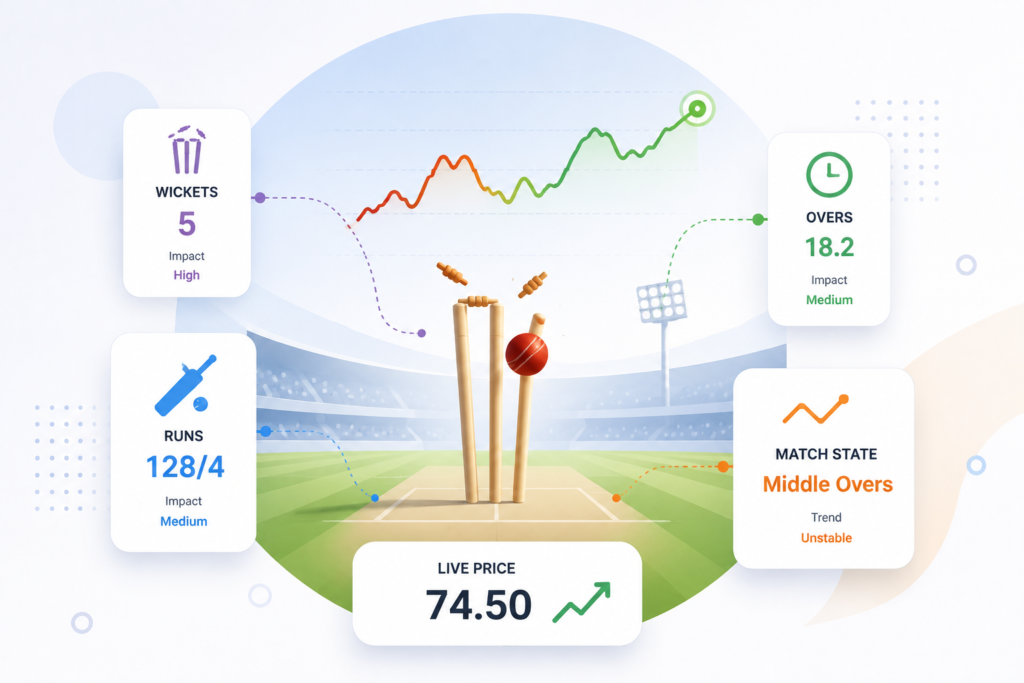
Live cricket prices can change dramatically after a single ball. A wicket, boundary, dropped catch, or change in the required run rate can alter how the market views the match.
A Cricket Exchange reflects changing expectations rather than a fixed prediction. When the match situation changes, the estimated probability of different outcomes can change too.
That is why two prices seen only seconds apart may look very different. The movement is usually connected to new information entering the market.
Understanding this process makes live markets easier to interpret. It also helps readers separate genuine changes in match conditions from short-term market noise.
Why Do Live Cricket Prices Move So Quickly?
Live cricket markets react because cricket is a continuously changing sport.
Every delivery can add new information. A six changes the score, a wicket removes a batter, and a dot ball can increase the pressure on a chasing team.
Several factors can influence a live price at the same time:
- Current score
- Wickets lost
- Overs completed
- Overs remaining
- Required run rate
- Current run rate
- Batting resources
- Bowling resources
- Partnership situation
- Batter and bowler match-up
- Pitch and weather conditions
- Market liquidity
- New information from the match
The market does not simply ask, “Who is ahead?”
It considers the current state of the match and how that state affects possible future outcomes.
For example, a team chasing 180 from 20 overs may look comfortable at 90/1 after 10 overs. If the same team reaches 90/5, the score is identical, but the match situation is completely different.
The remaining batting resources have changed. That can cause a substantial adjustment in the market.
Wickets Can Cause Large Price Changes
A wicket is often one of the most important events in a live cricket market.
This is because a wicket does more than remove one run-scoring opportunity. It removes a batter and changes the resources available to the batting side.
Consider a simple example.
A chasing team needs 60 runs from 48 balls with eight wickets remaining. The situation may appear manageable.
Now imagine the next delivery removes the team’s leading batter.
The target has not changed.
The number of balls has not changed.
But the resources available to complete the chase have changed.
A new batter must settle in. The remaining batters may have less experience or lower scoring ability. The bowling side may also gain greater control.
This explains why prices can move immediately after a wicket.
Not Every Wicket Has the Same Effect
The impact depends on who gets out and when.
A wicket may have a larger effect when:
- A set batter is dismissed
- A top-order batter is removed early
- A team loses wickets while chasing a difficult target
- A lower-order batter replaces an established scorer
- The wicket occurs during a high-pressure phase
- Few wickets remain
A wicket may have a smaller effect when:
- A lower-order batter is dismissed
- The batting side has strong resources remaining
- The match situation already heavily favors one side
- Plenty of overs remain
So, the event itself matters, but the context matters more.
Runs Change the Equation Too
Runs are another major source of live price movement.
A boundary can change the situation instantly, particularly during a chase.
Suppose a team needs 40 runs from 24 balls.
A six reduces the target to 34.
That may not sound enormous, but it also changes the required scoring rate and the pressure on the batting side.
Repeated boundaries can create even larger changes.
At the same time, a sequence of dot balls can increase pressure. The target remains unchanged, but fewer deliveries are available to score the remaining runs.
This is why live prices respond to more than the scoreboard.
The relationship between runs and balls remaining is often more important than the raw score itself.
Required Run Rate Matters
The required run rate is calculated by dividing the runs still needed by the overs remaining.
For example:
- Runs required: 48
- Balls remaining: 30
- Runs per ball required: 1.6
If the team scores 12 runs from the next six balls, the required target falls and the equation changes.
If the team scores only two runs, the pressure increases.
Live markets continuously respond to these changes because the probability of completing the target is no longer the same.
Overs Remaining Can Be More Important Than the Score
Two teams can have the same score but very different match positions.
Imagine these two situations:
| Situation | Score | Wickets Lost | Overs Remaining |
| A | 120/2 | 2 | 10 |
| B | 120/6 | 6 | 10 |
The score is identical.
The number of overs remaining is identical.
Yet the match state is clearly different.
Team A has more batting resources available. Team B has fewer wickets and may have less scoring depth.
This illustrates why live cricket prices cannot be understood from runs alone.
The market considers the combination of variables.
Match State Brings Everything Together
Match state is one of the most useful concepts for understanding live price movement.
It describes the complete situation at a particular point in the game.
For a limited-overs chase, this can include:
- Target
- Current score
- Wickets lost
- Balls remaining
- Required run rate
- Current partnership
- Batting resources
- Bowling resources
- Recent scoring pattern
- Match conditions
A price can therefore change even when there has been no dramatic event.
For example, a team may score only singles for several overs.
There may be no wicket.
There may be no boundary.
But the number of balls remaining is steadily falling.
If the team is not scoring quickly enough, the required rate rises. That gradual change can influence market expectations.
This is why live markets are dynamic throughout an innings.
How Partnership Situation Influences Prices
A partnership can change the perceived stability of a batting innings.
A well-established pair can rotate the strike, find boundaries, and manage the required rate.
If that partnership breaks, the market may react.
For example, a team chasing 150 may be 80/2 after 12 overs. Two experienced batters are controlling the innings.
If one batter is dismissed, the new batter may need time to settle.
The market may therefore react to the wicket even though the target remains exactly the same.
This is a useful distinction:
The scoreboard shows what has happened. Match-state analysis considers what that event means for what may happen next.
Why Market Prices Can Move Before the Scoreboard Fully Changes
Live markets can sometimes react extremely quickly because participants are watching the same event in real time.
A wicket may be recognized immediately by viewers, data systems, commentators, and market participants.
The market can therefore begin adjusting as soon as the event becomes clear.
There can also be brief periods where a market is suspended around major events.
This is different from normal price movement.
Suspension vs Price Movement
A market suspension temporarily prevents normal trading while an important event is being processed or verified.
After the market reopens, prices may be different from where they were before the event.
For example:
Before wicket → Market suspended → Wicket confirmed → Market reopened → New prices
This process helps distinguish event-driven pricing from ordinary movement between buyers and sellers.
What Is Cricket Exchange Betting and Why Does Price Movement Matter?
The Cricket exchange betting involves an exchange-style market where prices represent the current expectations of participants.
Unlike a static pre-match view, a live exchange reflects new information as the game develops.
The key point is that a price should not be treated as a guaranteed prediction.
A changing price simply reflects a changing market assessment.
For educational purposes, readers should think about price movement in terms of probability and information, rather than assuming that every sudden move represents a certain outcome.
For example:
- A wicket can reduce the perceived chance of a successful chase.
- A rapid scoring sequence can improve that perception.
- A series of dot balls can increase pressure.
- A rain interruption can alter available overs.
- A change in target can completely reshape the match.
Each event adds information.
Why Liquidity Also Matters
Match conditions are not the only factor affecting displayed prices.
Liquidity refers to how much activity is available around different prices in a market.
A highly active market may have many participants offering or accepting prices.
A less active market can behave differently.
This matters because a relatively small amount of activity may sometimes move the displayed price more noticeably when there is limited liquidity.
Therefore, price movement has two sides:
- The cricket situation changes.
- Market participants react to that change.
The first explains why expectations change.
The second explains how those expectations appear through market prices.
Why Different Cricket Markets React Differently
Not every market responds to a wicket in exactly the same way.
A match-winner market focuses on the expected result.
Other markets may focus on:
- Total runs
- Innings totals
- Player performance
- Partnerships
- Overs
- Sessions
- Specific match events
A wicket can therefore have different effects across different markets.
For example, removing an opening batter early can matter greatly to a player-performance market.
The same event may have a more complicated effect on the overall match market because the remaining team resources also matter.
This is why it is useful to understand what a market is actually measuring before interpreting its price.
Common Mistakes When Reading Live Cricket Prices
Mistake 1: Looking Only at the Current Score
The score provides important information, but it is incomplete.
Always consider wickets, overs, target, and recent scoring.
Mistake 2: Treating Every Price Change as a Prediction
A market price is not a guarantee.
It reflects current expectations based on available information and market activity.
Mistake 3: Ignoring the Required Rate
In a chase, the remaining target and balls can quickly change the pressure.
Mistake 4: Ignoring Wickets in Hand
Two teams can have the same score and overs remaining but very different resources.
Mistake 5: Assuming One Event Explains Everything
A wicket may cause a large reaction, but the size of that reaction depends on the complete match state.
Was it a wicket, boundary, dropped catch, review, injury, interruption, or change in playing conditions?
These five questions provide a much better picture than looking at the displayed price alone.
Practical Example: How One Over Can Change the Market
Imagine a team needs 45 runs from 30 balls with seven wickets remaining.
During the next over:
- Ball 1: Dot ball
- Ball 2: Single
- Ball 3: Two runs
- Ball 4: Wicket
- Ball 5: Dot ball
- Ball 6: Single
The batting team has added only four runs and lost a wicket.
The target has become smaller by four runs, but the team has also lost a batter and six deliveries.
The market may respond because several variables changed together.
This example shows why live pricing cannot be reduced to one statistic.
Runs, wickets and balls interact with each other.
Key Takeaways
- Live cricket prices change because new match information changes market expectations.
- Wickets can cause significant movement because they reduce batting resources.
- Runs and boundaries change the remaining scoring requirement.
- Dot balls can increase pressure when limited deliveries remain.
- Overs and balls remaining are critical during a chase.
- Required run rate helps explain the changing difficulty of a target.
- Match state combines score, wickets, time, resources, and conditions.
- Liquidity can influence how strongly market activity appears in displayed prices.
- Different markets can react differently to the same cricket event.
- A market price represents an expectation, not a guaranteed result.
Conclusion
Live cricket prices move quickly because the match itself is constantly producing new information. A wicket, boundary, dot-ball sequence, changing required rate, or reduced number of overs can alter the expected path of the game.
The most useful way to understand a Cricket Exchange is to look beyond the number shown on screen. Consider the score, wickets, balls remaining, scoring rate, match conditions, and recent events together.
For readers exploring tigerexchange this broader view is more useful than focusing on price movement alone. Understanding how markets respond to changing match information can help readers interpret live cricket markets more clearly and make more informed decisions about the risks involved.
FAQs
Why do cricket prices change after a wicket?
A wicket removes a batter and changes the batting resources available. Its impact depends on the batter dismissed, the score, wickets remaining, and balls left.
Do more runs always mean better prices for the batting team?
Not necessarily. The effect depends on the target, wickets lost, balls remaining, and required scoring rate.
Why do prices sometimes move without a wicket?
Prices can change after boundaries, dot-ball sequences, changes in required rate, interruptions, injuries, or other new match information.
What does match state mean in live cricket?
Match state refers to the overall situation, including score, wickets, overs remaining, target, scoring rate, and available resources.
Why are wickets more important late in an innings?
There are fewer deliveries left to recover from a wicket. Losing an important batter can therefore have a larger effect on the remaining scoring options.
Does market liquidity affect price movement?
Yes. Liquidity describes the amount of market activity available at different prices. Lower liquidity can make displayed prices more sensitive to individual market actions.
Is a live exchange price a guaranteed prediction?
No. A market price represents a current expectation based on available information and market activity. It does not guarantee a particular result.
Why can two markets react differently to the same wicket?
Different markets measure different outcomes. A wicket may strongly affect a player-performance market while producing a different response in the overall match market.