

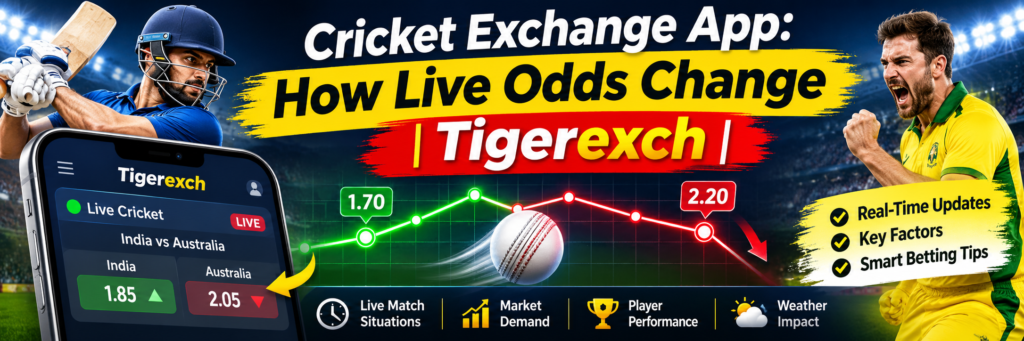
Live cricket odds can change several times in a single over. A wicket, a boundary or a string of dot balls can move prices in seconds, and for anyone new to in-play markets these swings can look random. They are not. Every movement is the market reacting to new information from the field.
A cricket exchange app puts those changing prices next to the live match, so you can see the market respond ball by ball. This guide explains why in-play prices move, which events cause the biggest changes, what terms like shortening and drifting mean, and how to read live odds calmly on Tigerexch.
Why Do Live Cricket Prices Change So Quickly?
Before the first ball, the market prices a match on team strength, conditions and form. Once play starts, every delivery adds new information. Runs are scored, wickets fall, balls run out and the required rate moves. Each change shifts how likely each outcome looks, and the price moves with it.
The stage of the match matters as much as the event itself. A wicket in the second over of a T20 is not the same as a wicket in the final over of a tight chase. The event is identical, but the time and batting resources left are completely different.
Reading a Cricket Exchange App Alongside the Match
The best way to read a live price is as part of the wider match picture. Imagine a team chasing 160 that needs 65 runs from 48 balls with seven wickets in hand.
If the next over goes for 12 runs without a wicket, the target drops and the batting side keeps its resources, so the market moves in its favour. If the next over brings three runs and a wicket, the target has barely changed while the resources have shrunk, and the market moves the other way.
When a price moves, ask yourself:
- What was the situation before the latest event?
- What happened in the last over?
- How did it change the target, balls remaining or wickets in hand?
- Has the scoring pattern changed?
What Happens to Prices After a Wicket?
A wicket removes a batting resource, so it usually causes a clear movement. The size of that movement depends on the situation. A team needing 75 from 90 balls with eight wickets left has plenty of time to recover. A team needing 20 from 12 balls with four wickets left has almost none.
Who gets out matters too. Losing a set batter on 70 changes a chase more than losing a tail-ender. The wicket is the event, but its meaning comes from everything around it.
Boundaries, Dot Balls and Momentum
Boundaries change the score instantly. A six in the powerplay adds useful runs, but a six in the 19th over of a close chase can swing the match.
Dot balls work the other way. They add nothing to the score but use up deliveries, so a run of dots in a chase raises the required rate and the pressure. Four overs of 10, 8, 12 and 9 runs tell a very different story from four overs of singles, dots and a wicket, even if the total looks similar. Momentum is a useful way to describe this recent pattern, although it never guarantees what comes next.
Why Required Run Rate Matters in a Chase
A team needing 60 runs from 48 balls must score at 7.5 runs per over. If it scores 12 in the next over, it needs 48 from 42 balls, and the required rate drops to about 6.9. If it scores three and loses a wicket instead, it needs 57 from 42 balls, the rate climbs above 8 and one batting resource is gone.
The required rate is most useful when read with:
- Runs required and balls remaining
- Wickets in hand
- The recent scoring rate
- The batters at the crease
- The phase of the innings
Why Prices Can Move Without a Wicket
Some fans expect big moves only after wickets, but markets also move during ordinary overs. If a team needing 45 from 30 balls scores 14 in an over, the target shrinks and the required rate falls. If it scores four from the same over, no wicket has fallen, yet the task has become harder. Both changes are enough to move the price.
Shortening and Drifting: What They Mean
A price is shortening when the market sees an outcome as more likely, for example moving from 2.50 to 2.00. A price is drifting when the market sees it as less likely, such as moving from 2.00 to 2.50.
These terms describe market movement, not certainty. A team that looks strong after a big over can lose two wickets in the next few balls, so every price is a snapshot of that moment.
Why a Price Can Move Before You See the Ball
TV broadcasts, online streams, scorecards and live data feeds do not update at exactly the same time. A stream can run several seconds behind the data feed, so you may see a price move before the delivery appears on your screen. Keep this in mind when following live markets, especially in the closing overs.
How Tigerexch Makes Live Odds Easy to Follow
Tigerexch brings the main live cricket markets together in one place. Live Odds come from Betfair exchange markets, Bookmaker Odds offer Indian book markets with higher stake limits, and Fancy and Premium Fancy markets cover sessions, player runs and more. You can follow the match and the market on the same phone screen.
- Quick start: message the team on WhatsApp and get your ID within minutes.
- Fast payments: deposits through UPI, PhonePe, GPay, Paytm, bank transfer or USDT are processed within seconds, and withdrawals within 10 minutes (up to 45 minutes outside banking hours).
- 24/7 support: help is available at any hour on WhatsApp, Telegram, Instagram and X.
- More than cricket: football, tennis and other sports, plus over 1,500 casino games and 200+ Indian casino games.
A Simple Example of In-Play Movement
In a T20 chase of 170, the batting side is 72/2 after 10 overs and needs 98 from 60 balls.
Scenario A
The next three overs bring 35 runs and no wickets. The side now needs 63 from 42 balls with eight wickets in hand, and the market moves strongly in its favour.
Scenario B
The same three overs bring 18 runs and two wickets. The side needs 80 from 42 balls with six wickets left, the required rate is above 11, and the market moves towards the bowling side.
The score moved forward in both scenarios, but the match situation went in opposite directions. That is why live prices depend on runs, wickets and balls together.
Common Mistakes When Reading Live Odds
- Focusing on the last ball only: look at the last two or three overs as well.
- Ignoring wickets in hand: a manageable required rate can become very difficult after a collapse.
- Forgetting balls remaining: the same target means different things with 60 balls or 12 balls left.
- Treating a price as a certainty: prices show expectations, not results.
- Reacting to speed: a fast move is not always a meaningful one, so check what caused it first.
A Simple Routine for Following Live Cricket Data
- Check the score and wickets.
- Check the overs or balls remaining.
- In a chase, check the required rate.
- Review the last few deliveries.
- Identify what changed and compare it with the previous situation.
- Look at the market price last, with the match context in mind.
How Formats Change Live Movement
In T20 cricket, a few deliveries are a large part of the innings, so one expensive over or two quick wickets can change the match quickly. ODIs give more time to recover, so single events are read within a longer pattern. In Test cricket, time left in the match, wickets and the overall position often matter more than a short scoring burst.
Play Responsibly
Live markets move quickly, and that speed can encourage emotional decisions. No formula guarantees a cricket result: strong positions are lost and teams under pressure recover through a single partnership or spell. Set a budget before the match, avoid chasing losses and take breaks. Tigerexch encourages responsible play, and accounts are only for users aged 18 and above.
Key Takeaways
- Live cricket prices move because every delivery adds new information.
- The impact of a wicket depends on runs required, balls remaining and wickets in hand.
- Boundaries, dot balls and the required rate can move prices even without a wicket.
- Shortening and drifting describe market movement, not certainty.
- Streams and data feeds update at different speeds.
- A cricket exchange app like Tigerexch shows the match and the market together, with fast payments and 24/7 support.
Conclusion
Live cricket odds make sense once you connect each price to what is happening on the field. Read the score, wickets, balls remaining, required rate and recent overs together, and the market’s movements stop looking random. Tigerexch gives you Betfair-based Live Odds, Bookmaker and Fancy markets on one screen, with quick WhatsApp setup, fast UPI payments and support around the clock. Message the Tigerexch team on WhatsApp to get your ID before the next big match.
FAQs
Why do cricket odds change during a live match?
Odds change because every delivery adds new information, such as runs, wickets, balls used and changes in the required rate.
Does every wicket cause a big price change?
No. The effect depends on the target, balls remaining, wickets already lost and the stage of the innings.
Can odds change without a wicket?
Yes. Boundaries, dot balls and a change in the required rate can all move prices.
What does a shortening price mean?
It means the market sees an outcome as more likely than before. It does not mean the outcome is certain.
What does a drifting price mean?
It means the market sees an outcome as less likely than before. The price can move again with the next event.
Why does the price move before I see the ball on my stream?
Live data feeds often update faster than TV broadcasts or online streams, so the market can react before the delivery appears on your screen.
Which markets can I follow on Tigerexch?
Tigerexch offers Live Odds from Betfair markets, Bookmaker Odds, Fancy and Premium Fancy markets for cricket, along with football, tennis and casino games.
How do I get a Tigerexch ID?
Message the Tigerexch team on WhatsApp. Your ID is set up and shared in the same chat, usually within minutes.